
Dated February 27, 2023. Performance information has been removed from this version in accordance with the firm's policy on publicly available materials, adopted in 2026. Because the removals were made largely by cutting rather than rewriting, some passages are incomplete or end abruptly. Performance information is available to qualified investors on request — contact ir@philipequities.com.
Interpretation of Results
The fund makes long-term oriented investments (measured by a 3-5 year period), so any 12-month period of mark-to-market stock price performance will not reflect the business performance of the portfolio companies.
Stance on Current Market Paradigm
Not all the bezzle has been deflated out of the bubble; however, widespread pessimism and depressed valuations for specific productive assets that the fund owns creates opportunity to achieve abnormally strong returns over the next few years as market participants decipher between justly beaten down stocks and these unjustly beaten down stocks.
In general, there is now no extreme exuberance, but also no extreme pessimism, so I have no material stance on the current market paradigm. Instead, I am holding extremely undervalued stocks for the long-term. In general, I by and large focus on specific businesses and avoid economic/market cycle considerations; however, during obvious extreme exuberance and obvious extreme pessimism, I marginally adjust net exposure and the industries the Fund allocates capital to.
For example, during the depths of COVID, there was extreme pessimism, which the fund cheerfully capitalized on by purchasing businesses trading at irrationally distressed prices (e.g., AerCap and Sallie Mae).
Conversely, going into 2022 there was extreme market exuberance. Thus, in the 2021 annual letter, the fund’s “Stance on Current Market Paradigm” section indicated the fund would make adjustments for a “windy environment.” Within this section, existed a subsection titled “View on Crypto & Other Speculative Assets,” which was originally a letter I wrote to a friend in response to a Su Zhu podcast he recommended I listen to. In this subsection I warn my friends about the dangers of speculating, falsify the speaker’s “valuation” methodology, and juxtapose this valuation methodology with my valuation methodology. Soon, speculative stocks tanked, Su Zhu’s Three Arrows Capital went bust, and the economy weakened. I highly recommend reading this piece, which I believe was a timeless subsection that may save readers money throughout their lifetimes.
Shorts
As described in the 2021 annual letter, the fund put on short positions for the first time due to the extreme market exuberance. In short (no pun intended), the theses behind the shorts were simple: extremely overvalued businesses with positions sized appropriately to ensure the fund would not be forced to sell the position at a loss should the mark to market price transitorily go (way) further (irrationally) upward. As discussed in the last annual letter, I do not disclose live short positions, but these shorts were all closed so can be disclosed: Tesla, AMC Entertainment, Gamestop, Rivian, Lucid Motors, L’Oréal, Netflix, Hilton Worldwide.
Positive Contributors to Performance on the Long Side
The Fund’s largest position going into the crisis was Imperial Brands. This thesis was included in Philip Equities, LP’s 2021 annual letter. The thesis began playing out as the combustible-focused tobacco player initiated a substantial share repurchase program to complement the significant dividend.
Georgia (the country not the state) has been an outperformer this year, and Bank of Georgia, one of the Fund’s largest holdings, which was discussed in the 2021 annual letter, was a standout performer in 2022. Despite Georgia’s two largest trading partners going to war, Georgia achieved the strongest GDP growth among regional and European economies. The Russian invasion of Ukraine caused an immediate irrational decline in the bank’s stock price, which the Fund used to opportunistically purchase more shares (practically at bottom tick). Also, the bank’s first-ever share repurchase program, which I successfully convinced management to initiate, began this year complementing the bank’s significant dividend. It should be noted that unlike other Eastern European investors, I specifically avoided otherwise attractive investments in Russia and Ukraine due to geopolitical risk. I maintain my position that Georgia’s perceived geopolitical risk is meritless.
Negative Contributors to Performance
As you are aware, the Fund obviously had poor performers this year.
The fund owned Qurate Retail, which it sold on the last trading day of the calendar year (timing for tax purposes). The stock declined 78.55% in 2022. The business was impacted by supply chain issues, consumer demand deterioration, higher interest rate impact on leveraged balance sheet, and an unexpected fire at a core distribution center. Additionally, the elevated 2021 profitability made the below trend profitability in 2022 appear more concerning to fixed-income investors. Consequently, management reallocated cash flow from dividends to debt paydown. Due to these issues, the business’s intrinsic value declined; however, the market value has fallen far more steeply. Nevertheless, I consider this investment to be the Fund’s second mistake. (The Fund’s first mistake, if you recall, was an investment in a VIE entity that continues to claim ownership in Momo). Evidently, in this environment, the business’s free cash flow available to equity has come under pressure, and while the business is still producing hundreds of millions in earnings power, it is conceivable that the business could go bankrupt should the myriad headwinds all continue and worsen in a possible consumer-led recession.
When one invests in the S&P 500, there are bound to be winners and losers. Similarly, when one invests with an active manager, there are bound to be winners and losers in the active manager’s portfolio. Some managers accept some sort of “batting average.” Conversely, I consider any investment mistake to be a personal disgrace. In fact, any mistake can jeopardize my mother’s retirement; I have finally enabled my mother to retire, and she (like me) has by and large all of her net worth invested in the portfolio’s businesses except for a few months of cash. I am single-mindedly determined to maximize long-term investment results, which includes reducing capital allocation mistakes to as close to zero as possible.
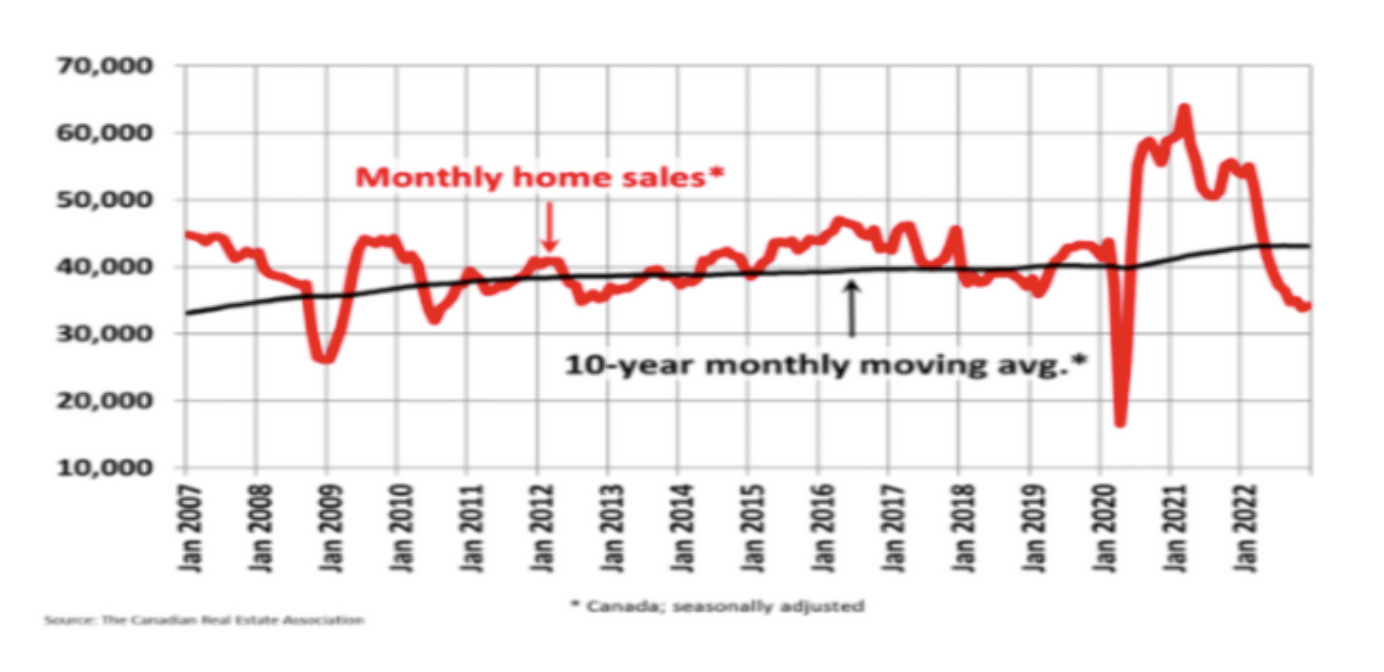
Another detractor from this year’s mark-to-market performance was a software company, which is now the fund’s largest holding. The stock declined 63.44% this year despite an increase in intrinsic value. The CEO of the business has responded by purchasing shares aggressively with his own money and the company’s money; I have done the same. The company has a relatively economically insulated business law business. Roughly 2/3 of the business’s revenue is related to Canadian, Australian, and UK real estate. Importantly, the business’s real estate business is not impacted by falling home values as the company gets paid on home transactions. Please take note that in the chart below home sales fluctuate over time within a band that trends up (it is common sense that people will not stop buying homes forever, but investors do not seem to have common sense).
The company’s software is price inelastic. Law firms use the service and push the cost onto their clients. The clients do not notice increases in cost, or if they do notice, it is not worth their time to complain, because the cost for the software is a small component of a much larger legal bill. Management recognizes this paradigm as evidenced by their price increases. For example, for one of their products, they raised price from $25 to $129 in 2021, and then in 2022 from $129 to $249, or a nearly 1000% price increase in two years. This level of pricing power is unusual even compared to tobacco, which is known for price inelasticity.
Due to price increases, the company’s earnings power has been resilient through this trough period for the business; however, stock investors have ignored this fact and have instead focused on the transitory trough in home sales. We believe the fund may benefit from what we consider a mispricing.
With very few exceptions, dramatic downward fluctuations in share price for holdings provide the best opportunities for the fund to become extremely concentrated in particularly cheap stocks. This occurred during the Apple selloff early 2019, it occurred in the case of Sallie Mae and AerCap during the Covid crisis in 2020, and it is occurring now. We should cheer for major downward fluctuations in our holdings because these selloffs are the valuable seeds of abnormally strong long-term returns. I invest based on a rough estimate of normalized earnings or cash flow, and look past cyclicals troughs or peaks in these metrics. Most high-IQ market participants, such as mutual funds and hedge funds, focus on recent business results and their expectation of near-term business results relative to market expectations. Other market participants, such as most quants and most retail investors, do not attempt to estimate intrinsic value. Thus, considering the tiny percentage of market participants who compete to value businesses, it should be expected that, from time to time, an easy (1-foot hurdle) opportunity to acquire a business at a price that obviously does not reflect long-term intrinsic business value can be identified and thoroughly seized.
New Investments
On the long-side, the fund made two new investments in 2022.
One, in a small medical device company with a capable CEO and a special product. The firm has been developing an interesting technology for nearly a decade, and is finally in the commercialization phase. I believe the business has potential to generate meaningful cash flow as it progresses through commercialization. It seems to be trading at a low single-digit multiple to 2024 cash flow, and I believe the business has potential for significant growth from its early-stage base.
The second new investment is in a midcap subprime lending business. The business has a double-digit dividend yield, is buying back a material percentage of shares each quarter, and generates net interest margins, which, when coupled with their reserves, ensures the business will manage the inevitable downturns over time.
Philip Equities as a Business
I started Philip Equities, LP from my dorm at the University of Southern California with the assumption that it would take ten years to raise outside capital, and I accepted the possibility that I would consequently be homeless for 10 years. To the surprise of family and friends, I found this path extremely attractive because life would be thoroughly enjoyable so long as I could spend time without folks disturbing my investment process, and because investing my way would logically produce attractive long-term returns that would eventually attract significant institutional capital. This conviction is not only unwavering but has been intensely reinforced during my cherished time with my late and extremely great mentor, by the fund’s myriad successful (and scalable) investments. Six more years…
Joshua B. Barach
Founder & Chief Investment Officer
Legal Information and Disclosures
This letter was originally distributed on February 27, 2023. Performance information has been removed from the version published here, in accordance with the firm's policy on publicly available materials, adopted in 2026. Because the removals were made largely by cutting rather than rewriting, some passages are incomplete or end abruptly. No other facts have been altered.
This letter is published by Philip Equities and may be read and shared in the form in which it appears here. It may not be altered, excerpted in a way that misrepresents its contents, or presented as the complete letter as originally distributed.
This letter does not constitute an offer to sell or a solicitation of an offer to buy any securities. Any offering of interests in Philip Equities, LP and/or Philip Equities II LP will be made solely pursuant to the Fund's Private Placement Memorandum and related subscription documents, which govern in all respects and should be read in their entirety prior to any investment decision.
Performance Presentation: Performance information has been removed from the version of this letter published here, in accordance with the firm's policy on publicly available materials. It is available to qualified investors on request, together with the disclosures that accompany it. Past performance is not indicative of future results. Wherever there is the potential for profit, there is also the possibility of loss.
Investment Examples: References to specific securities, including both profitable investments (Imperial Brands, Bank of Georgia) and unprofitable investments (Qurate Retail), are provided for illustrative purposes only. They may not be representative of all investments made by the Fund. The securities discussed may not be held at the time of reading and positions may change without notice.
Short Positions: This letter discloses short positions that were closed during 2022, including Tesla, AMC Entertainment, GameStop, Rivian, Lucid Motors, L'Oréal, Netflix, and Hilton Worldwide. Short selling involves unlimited potential loss and may not be suitable for all investors. Past short selling results do not guarantee future performance.
An investment in a private investment fund is speculative and involves a high degree of risk. Opportunities for withdrawals or redemptions are restricted, so investors may not have access to capital when needed. There is no secondary market for interests in private investment funds and none is expected to develop. An investor should not make an investment unless it is prepared to lose all or a substantial portion of its investment.
Forward-Looking Statements: This letter contains forward-looking statements, including statements regarding expected returns, business prospects, and market conditions. Such statements reflect views as of the original publication date and are subject to risks and uncertainties that could cause actual results to differ materially. Philip Equities undertakes no obligation to update any forward-looking statements.
Nothing herein should be construed as legal, tax, or investment advice. Prospective investors should consult their own advisors regarding legal, tax, and financial considerations relevant to their particular circumstances.
© 2023 Philip Equities, LP.